Safety explained
Helmet law, standards and SHARP, from the source
What UK law requires, what ECE 22.05 and 22.06 mean, and what SHARP’s star ratings measure, in the official sources’ own terms. Helmet Scout adds no safety advice of its own: every point below is numbered to where it comes from, so you can read the original.
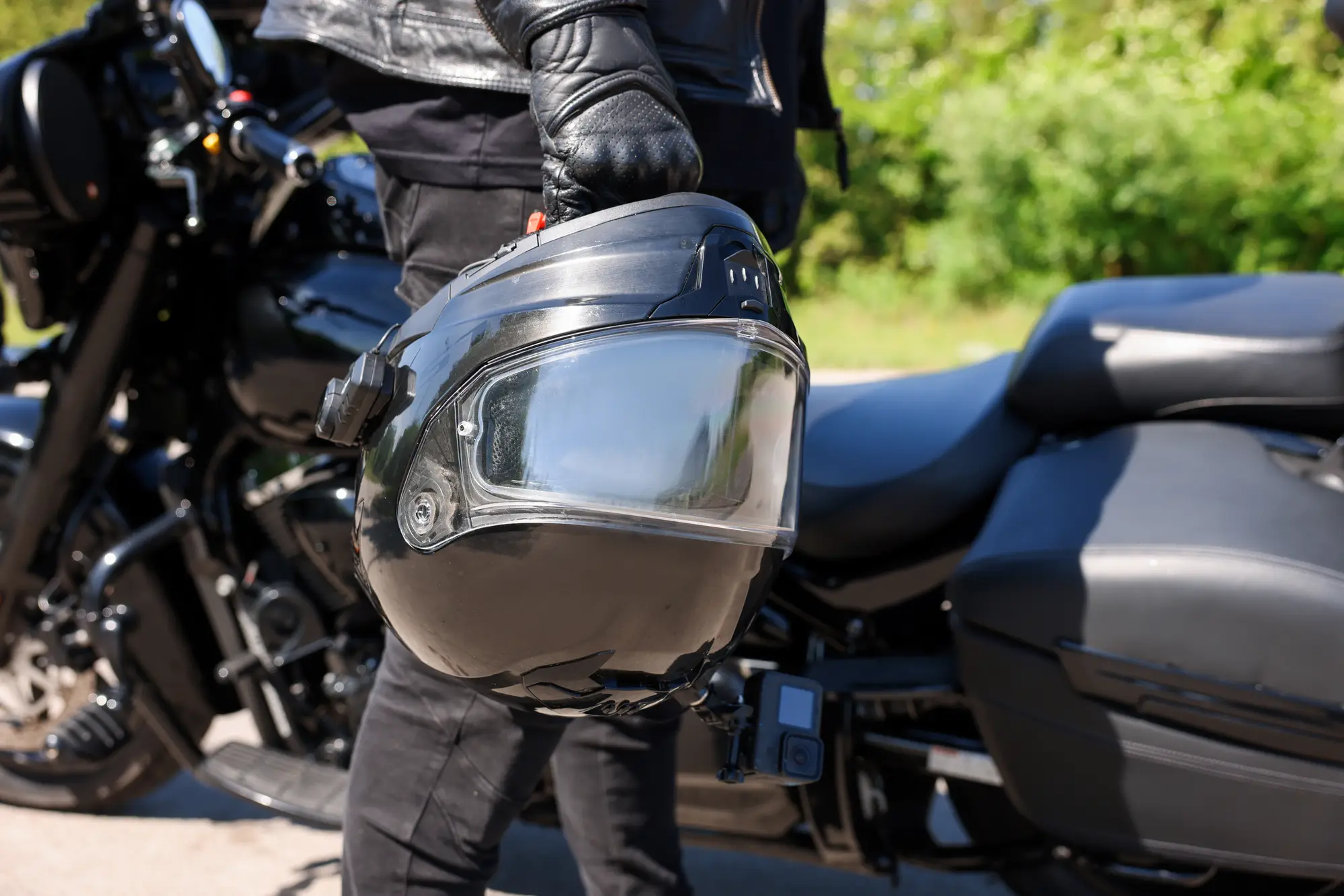
Helmet law in the UK
- GOV.UK: "You must wear a helmet that meets safety standards when riding a motorcycle or moped on the road."[1]
- Every helmet worn on UK roads must meet one of: British Standard BS 6658:1985 and carry the BSI Kitemark; UNECE Regulation 22.05; UNECE Regulation 22.06; or a European Economic Area member standard offering at least the same safety and protection as BS 6658:1985, with a mark equivalent to the BSI Kitemark.[1]
- Visors and goggles, if you ride with them, must also meet a standard: a British Standard with a BSI Kitemark, UNECE Regulation 22.05 or 22.06, or a European standard offering at least the same safety and protection, with an equivalent mark.[1]
- SHARP adds that "Visors that transmit less than 50% of visible light do not fully comply with any of the standards and cannot legally be used on the road."[2]
- There's no law about wearing other protective clothing, though GOV.UK says specialised motorcycle gear "is highly recommended".[1]
ECE 22.05 and 22.06
- From January 2024, helmet makers can only get approval for new designs that comply with UN ECE R22-06. SHARP notes that "ECE" doesn't mean a European-only standard: it's a global standard set by the UN.[3]
- SHARP says the standard and testing process for ECE R22-06 is higher than for R22-05, "and consequently a helmet marked ECE R22-06 offers better protection to riders".[3]
- ECE R22-05 helmets worn in the UK remain compliant: SHARP says "you do not need to rush out and replace your helmet immediately", but suggests watching the date of manufacture on any R22-05 helmet still on sale.[3]
- If you have a choice between two helmets, one marked 05 and the other 06, SHARP recommends the ECE R22-06 one "so that you benefit from the higher safety standards and longer life before it needs replacing". It says fit and comfort come first.[3]
- How to tell: an R22-06 helmet should say ECE R22-06 on the outside at the back of the neck, and have a fabric label with an E in a circle and a number (E11 means it was approved in the UK), "06" for the standard, and a letter for the type.[3][4]
- On the label, J means an open-face helmet (no approved protective chin bar), P means an approved protective chin bar, and P/J means a modular helmet approved for use with the chin bar closed or in its maker-approved open position. A modular helmet approved only as P must be ridden with the chin bar closed and locked.[4]
- On age: SHARP reports "the consensus in the industry is to recommend replacing a helmet after 5 years, regardless of whether it has been used or not", and its helmet care page says a helmet generally has a life of around five years, three if used regularly. The date of manufacture is usually on a sticker under the lining.[3][2]
Getting the right fit (SHARP's guide)
- SHARP: "The most important thing to consider when choosing your helmet isn't the brand name or how it looks. The secret to providing yourself better head protection is in getting the right fit."[9]
- SHARP cites the COST 327 study: 12% of helmets were lost during the impact. "Even a SHARP five-star helmet won't protect you if it's not on your head at the point of impact."[9]
- Its order of play: try on as many helmets as possible, then choose the one with the highest SHARP rating from those that fit you best.[9]
- Get measured: SHARP suggests measuring around your head just above the ears and at the forehead, and notes that a medium in one brand may be different to a medium in another.[9]
- Try it on and check the fit: SHARP's guide covers how tight the chin strap should be, checking for pressure points, rotating and tilting the helmet to see if it moves or slips, and a roll-off check with someone's help. Follow SHARP's full guide.[9]
Sources
- [1] GOV.UK: Motorcycle helmets and safety equipment, checked 9 Oct 2026
- [2] SHARP: Helmet care, checked 9 Oct 2026
- [3] SHARP: ECE R22-06: what you need to know about the new helmet standard (4 Sep 2024), checked 9 Oct 2026
- [4] SHARP: The anatomy of a label: what do the J, P or P/J markings mean? (23 Sep 2026), checked 9 Oct 2026
- [5] SHARP: SHARP testing, checked 9 Oct 2026
- [6] SHARP: helmet rating pages (sidebar, "How the helmets are tested"), checked 9 Oct 2026
- [7] SHARP: What does the latch score mean in SHARP ratings? (23 Jan 2026), checked 9 Oct 2026
- [8] SHARP: Does SHARP work? YES, it does! (1 Jun 2026), checked 9 Oct 2026
- [9] SHARP: Get the right fit, checked 9 Oct 2026
GOV.UK and SHARP content is published under the Open Government Licence v3.0. Quotes are exact; other points are summaries of the source. Each source shows the date we last checked it; we plan to re-check them on a schedule.
Safety ratings and test results: SHARP, Department for Transport. Contains public sector information licensed under the Open Government Licence v3.0. Helmet Scout isn’t connected to or endorsed by SHARP or the Department for Transport.